



How can you make an impact with your idea or insight?
Be inspired by the winners of the 2025 Valorisation Festival Award.
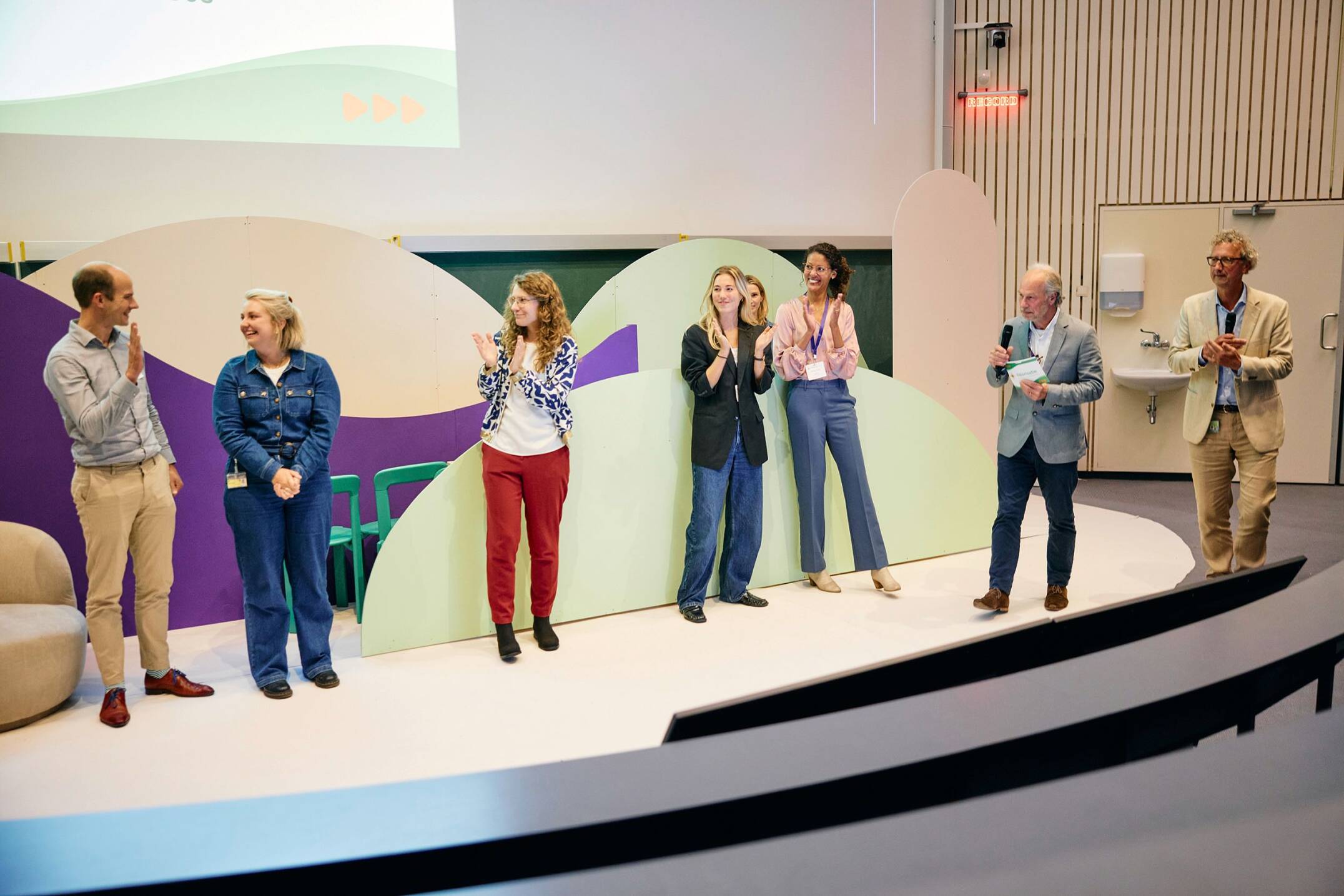
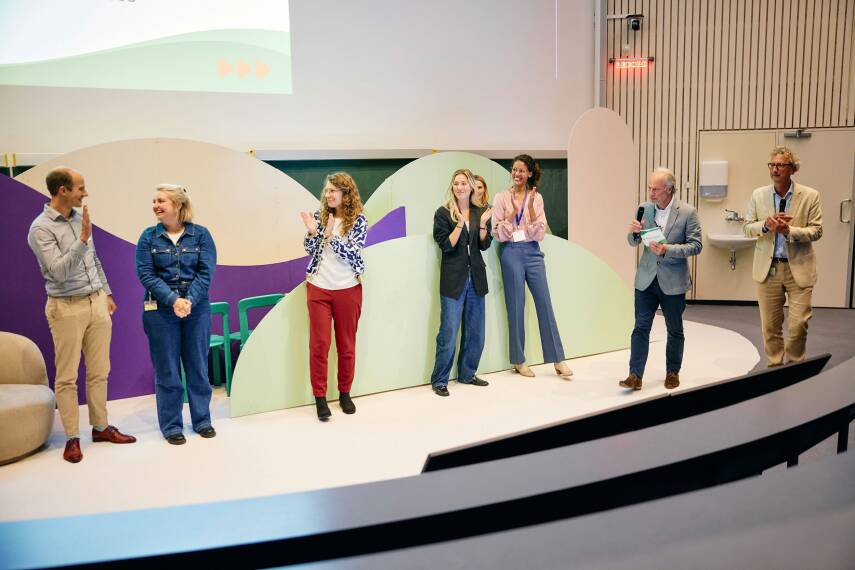
Researchers, healthcare providers, educators, technicians, consultants, and other Amsterdam UMC staff are joining forces to bring knowledge and ideas to society. Like these three impact makers. They won the 2025 Valorisation Festival Award in September.
TrianecT to launch new stroke triage system
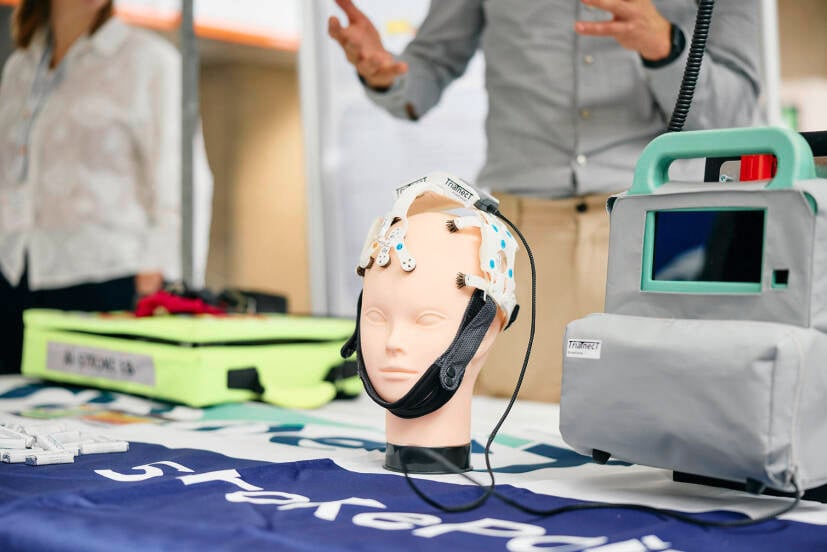
After a stroke, patients must receive the right treatment as quickly as possible to prevent further brain damage. However, if a major stroke is diagnosed at the nearest hospital, the patient often must be transferred elsewhere for the right intervention. CEO and technical physician Wouter Potters of TrianecT: "Every minute counts in a stroke. If the diagnosis is already clear in the ambulance, the patient can be taken directly to the right hospital."
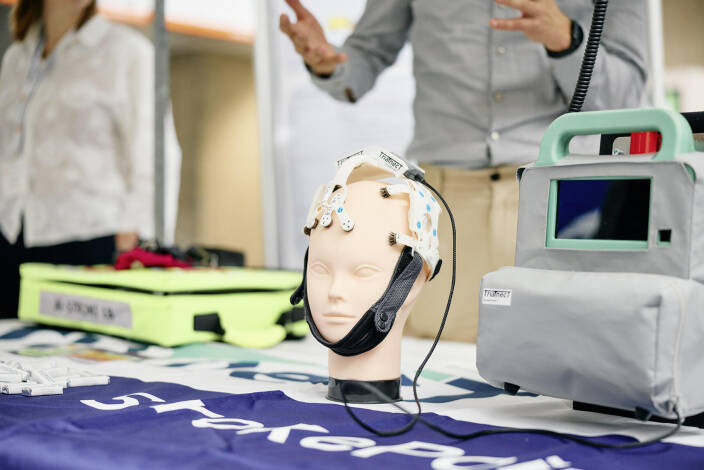
To this end, he developed the StrokePointer in collaboration with professor and neurologist Jonathan Coutinho and professor of radiology Henk Marquering: a 'smart swim cap' with electrodes that can be used to measure brain activity in the ambulance. Between 2018 and 2025, prototypes of the StrokePointer were tested in practice: fifteen ambulances used the device and collected data from more than 1,000 patients. The device is being continuously developed for market launch by the spin-off company TrianecT.
Wouter Potters: "TrianecT was founded in 2022 as a start-up of Amsterdam UMC. We are now working with six colleagues on the validation of StrokePointer; two external financiers recently came on board with €1.35 million. This will enable us to advance towards our next milestone: CE certification. We are initially focusing on the Europe market."
The jury considered this project a wonderful example of how to put technology into practice. It covers all aspects of valorisation—from problem to solution, from solution to upscaling. This will enable stroke patients to receive the right treatment quickly soon and prevent further damage.
Want to know more? Watch the video about the StrokePointer.
Neurospector creates human nerve cells to test new drugs

The development of drugs for brain disorders is complex and often takes many years. Neurospector accelerates this process with innovative human disease models. Claudia Persoon: "About fifteen years ago, a technique was developed to grow nerve cells from stem cells of patients with neurological disorders. These cells represent the disease so well that you can test drugs on them without the need for laboratory animals. We have already tested nine drugs using this method."
Neurospector focuses on neurological, psychiatric, and neurodegenerative disorders. "We offer tailor-made research projects for drug development," explains Claudia Persoon. "Our goal is to further expand the number of applications, for example for ALS and Parkinson's disease. Our mission is to accelerate the development of new treatments and thus improve the quality of life of millions of people worldwide."
A valorisation initiative with great growth potential and a clear contribution to reducing the use of laboratory animals. For this reason, the jury of the Valorisation Festival presented Neurospector with an award.
Want to know more? See neurospector.com
Consultation hours for female employees with female-specific disorders
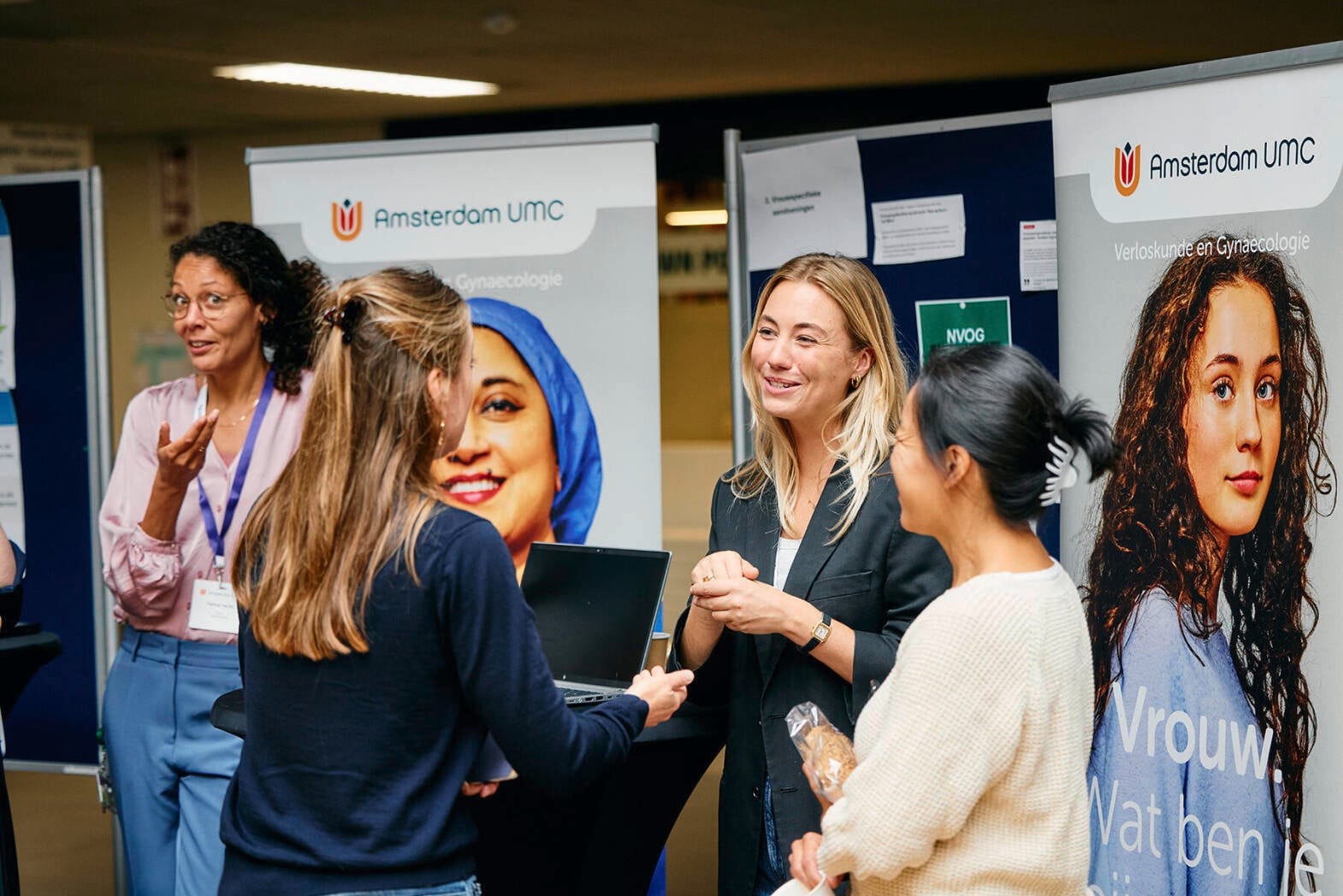
Three facts. One: a significant proportion (around 70%) of Amsterdam UMC's staff are women. Two: absenteeism among female employees currently stands at 7 percent. Three: hormone-related complaints often lead to absenteeism. Conclusion? Paying more attention to female-specific disorders among female employees could well contribute to greater vitality and less absenteeism.
At Amsterdam UMC, this idea led to the launch of the Female-specific disorders consultation hour. It turned out to meet a great need, says gynecologist Felicia Yarde. "We started in January. In the first six months, we received around 500 registrations and have seen 250 so far. The consultation hours are accessible and free of charge."
The consultation hour helps break the taboo; women feel heard and now dare to take the step. Felicia Yarde: "Many said: 'The fact that there is now a special consultation hour for this means that I am not the only one with these kinds of problems.'" More than two-thirds of them had already sought help but had not yet received a diagnosis. Most of them (80%) have now been diagnosed.
The aim of the consultation hour is therefore to shorten the time it takes to get the right diagnosis. Felicia Yarde: "This is desperately needed, because women with hormone-related complaints often have to wait 7 to 8 years before they receive a diagnosis. We provide guidance and advice on possible further examinations or treatment." The consultation hour is an initiative of gynecologist and professor Judith Huirne, who is committed to improving women's health in a variety of ways.
The jury of the Valorisation Festival called it a promising initiative, with the potential to make a significant impact both here and elsewhere. After all, more than half of the population is female, and many women-specific health issues are still surrounded by taboos.
Want to know more? See 'Free consultation hours for women'
Would you like to use the consultation hours as an employee?
Register via Consultation hours for female-specific disorders | Amsterdam UMC
Winnaars Valorisatie-award 2025

January 2026 | © Amsterdam UMC 2026



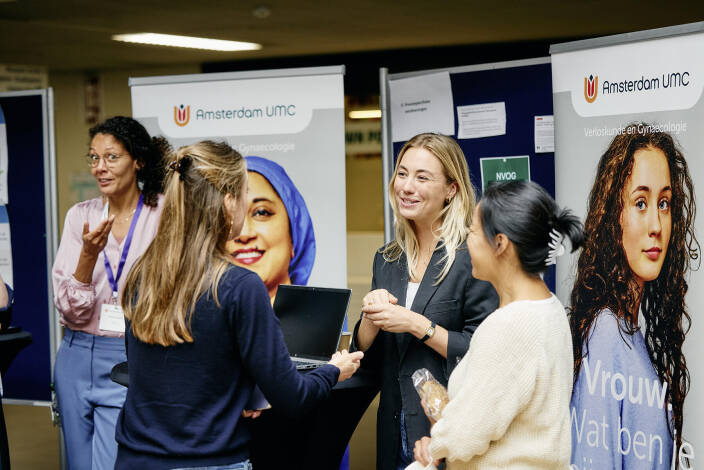
Three facts. One: a significant proportion (around 70%) of Amsterdam UMC's staff are women. Two: absenteeism among female employees currently stands at 7 percent. Three: hormone-related complaints often lead to absenteeism. Conclusion? Paying more attention to female-specific disorders among female employees could well contribute to greater vitality and less absenteeism.
At Amsterdam UMC, this idea led to the launch of the Female-specific disorders consultation hour. It turned out to meet a great need, says gynecologist Felicia Yarde. "We started in January. In the first six months, we received around 500 registrations and have seen 250 so far. The consultation hours are accessible and free of charge."
The consultation hour helps break the taboo; women feel heard and now dare to take the step. Felicia Yarde: "Many said: 'The fact that there is now a special consultation hour for this means that I am not the only one with these kinds of problems.'" More than two-thirds of them had already sought help but had not yet received a diagnosis. Most of them (80%) have now been diagnosed.
The aim of the consultation hour is therefore to shorten the time it takes to get the right diagnosis. Felicia Yarde: "This is desperately needed, because women with hormone-related complaints often have to wait 7 to 8 years before they receive a diagnosis. We provide guidance and advice on possible further examinations or treatment." The consultation hour is an initiative of gynecologist and professor Judith Huirne, who is committed to improving women's health in a variety of ways.
The jury of the Valorisation Festival called it a promising initiative, with the potential to make a significant impact both here and elsewhere. After all, more than half of the population is female, and many women-specific health issues are still surrounded by taboos.
Want to know more? See 'Free consultation hours for women'
Consultation hours for female employees with female-specific disorders
Would you like to use the consultation hours as an employee?
Register via Consultation hours for female-specific disorders | Amsterdam UMC
Researchers, healthcare providers, educators, technicians, consultants, and other Amsterdam UMC staff are joining forces to bring knowledge and ideas to society. Like these three impact makers. They won the 2025 Valorisation Festival Award in September.
How can you make an impact with your idea or insight?
Be inspired by the winners of the 2025 Valorisation Festival Award.
TrianecT to launch new stroke triage system
After a stroke, patients must receive the right treatment as quickly as possible to prevent further brain damage. However, if a major stroke is diagnosed at the nearest hospital, the patient often must be transferred elsewhere for the right intervention. CEO and technical physician Wouter Potters of TrianecT: "Every minute counts in a stroke. If the diagnosis is already clear in the ambulance, the patient can be taken directly to the right hospital."
To this end, he developed the StrokePointer in collaboration with professor and neurologist Jonathan Coutinho and professor of radiology Henk Marquering: a 'smart swim cap' with electrodes that can be used to measure brain activity in the ambulance. Between 2018 and 2025, prototypes of the StrokePointer were tested in practice: fifteen ambulances used the device and collected data from more than 1,000 patients. The device is being continuously developed for market launch by the spin-off company TrianecT.
Wouter Potters: "TrianecT was founded in 2022 as a start-up of Amsterdam UMC. We are now working with six colleagues on the validation of StrokePointer; two external financiers recently came on board with €1.35 million. This will enable us to advance towards our next milestone: CE certification. We are initially focusing on the Europe market."
The jury considered this project a wonderful example of how to put technology into practice. It covers all aspects of valorisation—from problem to solution, from solution to upscaling. This will enable stroke patients to receive the right treatment quickly soon and prevent further damage.
Want to know more? Watch the video about the StrokePointer.
The development of drugs for brain disorders is complex and often takes many years. Neurospector accelerates this process with innovative human disease models. Claudia Persoon: "About fifteen years ago, a technique was developed to grow nerve cells from stem cells of patients with neurological disorders. These cells represent the disease so well that you can test drugs on them without the need for laboratory animals. We have already tested nine drugs using this method."
Neurospector focuses on neurological, psychiatric, and neurodegenerative disorders. "We offer tailor-made research projects for drug development," explains Claudia Persoon. "Our goal is to further expand the number of applications, for example for ALS and Parkinson's disease. Our mission is to accelerate the development of new treatments and thus improve the quality of life of millions of people worldwide."
A valorisation initiative with great growth potential and a clear contribution to reducing the use of laboratory animals. For this reason, the jury of the Valorisation Festival presented Neurospector with an award.
Want to know more? See neurospector.com
Neurospector creates human nerve cells to test new drugs