







Why future generations are already our concern
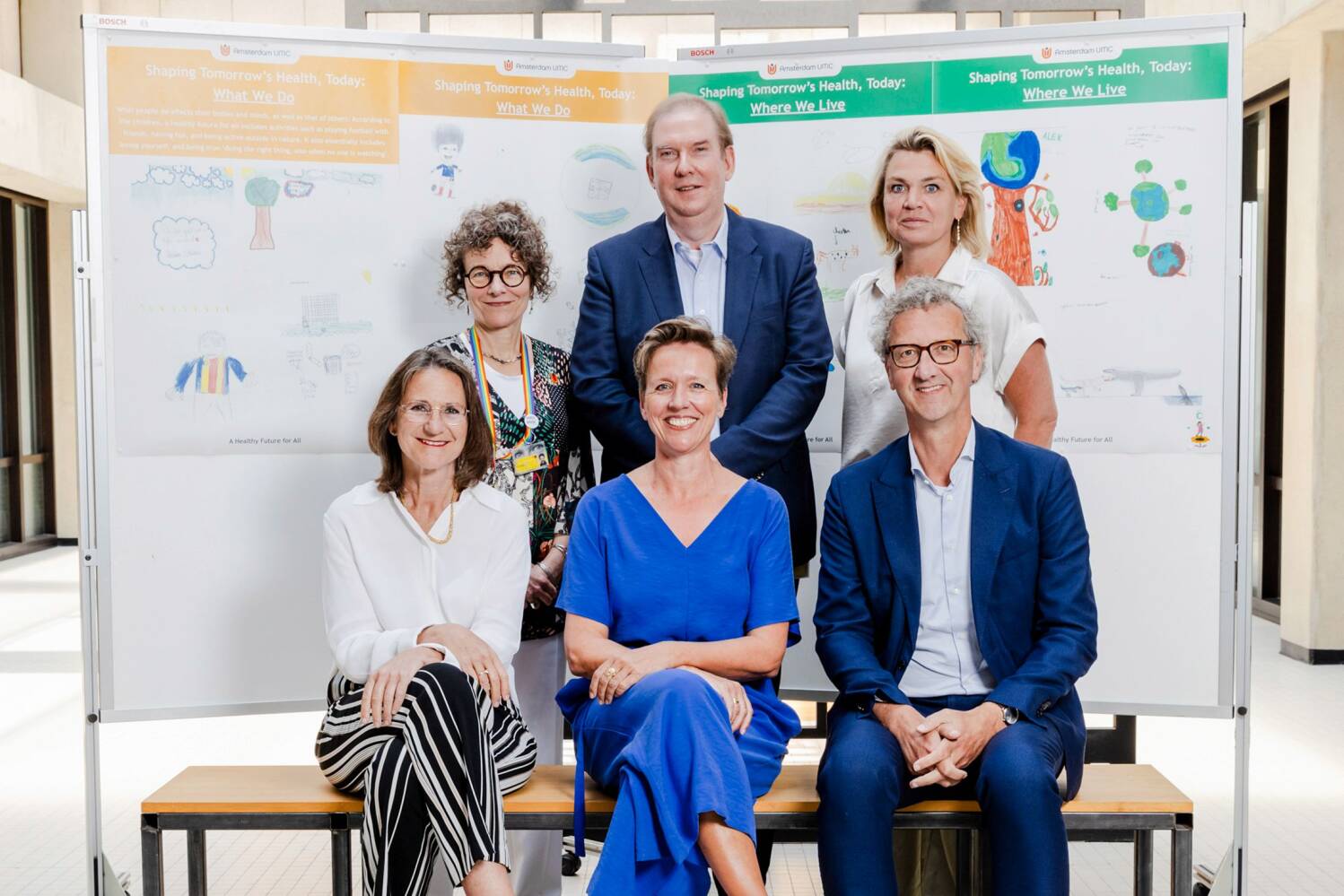
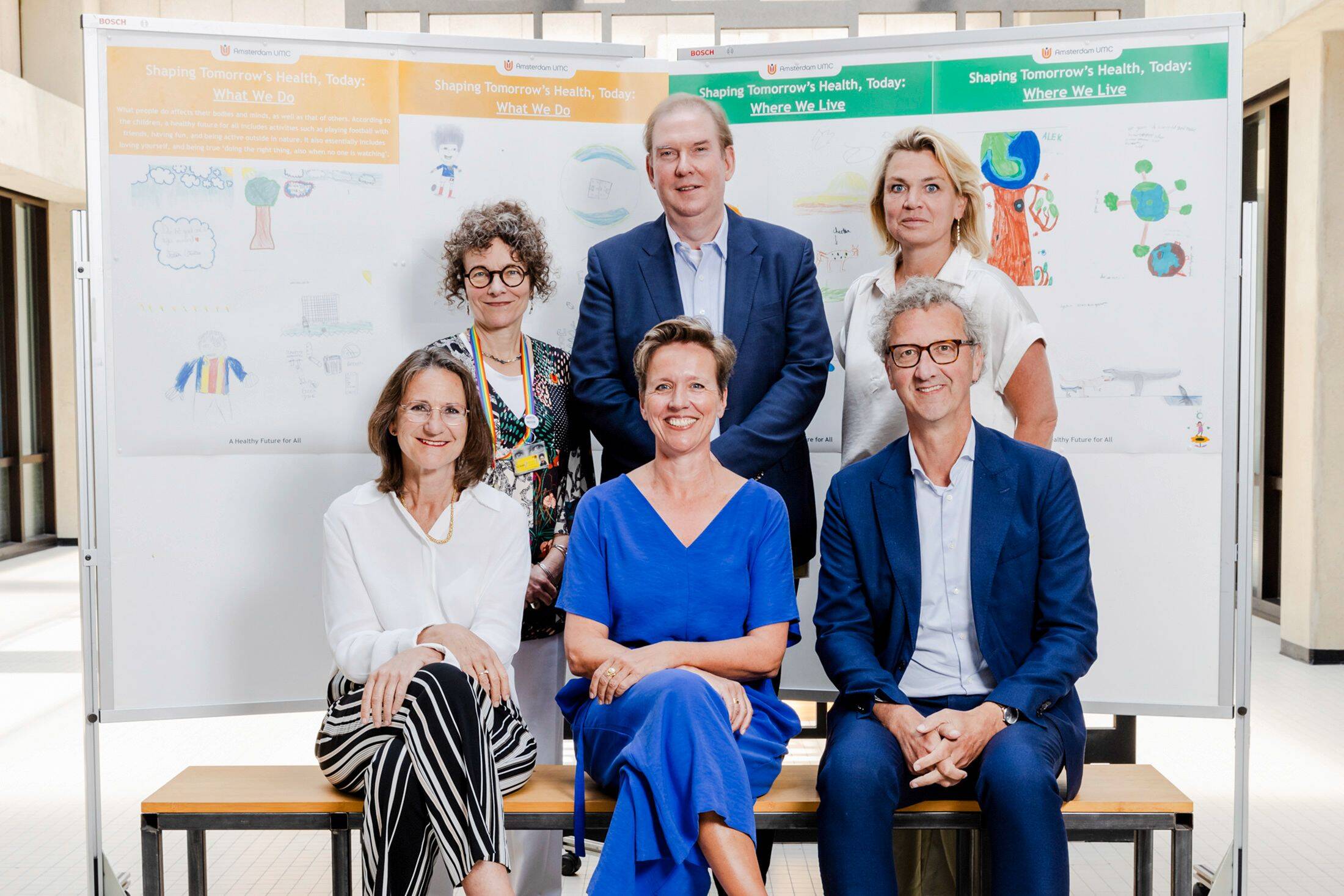
The board of directors of AmsterdamUMC and Tessa Roseboom (Future Generations Commissioner) at the opening of the exhibition ‘Draw the Future’. From left to right, from top to bottom: Karen Kruijthof, Yvo Roos, Saskia Peerdeman, Yvonne Koppelman, Tessa Roseboom, Hans van Goudoever.
Photo: Joyce van Doorn
It is our mission
It is our mission
At Amsterdam UMC, we are constantly gaining new knowledge and experience about health in healthcare, research, and education. The process of converting that knowledge and expertise into applications for society is called valorisation. Valorisation, or making an impact on society, is one of the core tasks of all university medical centers (UMCs).
The Netherlands Organization for Scientific Research (NWO, 2024) defines this task as: ‘Societal impact refers to the societal (cultural, economic, industrial, ecological, or social) changes that are (partly) the result of knowledge and expertise generated by research. These changes contribute to the well-being of people, planet, and society for present and future generations.’
It is our mission
It is our agreement
This is our strategy
It is our moral duty
It is our passion

Future Generations | March 2026
© Amsterdam UMC 2026
Why future generations are already our concern
The board of directors of AmsterdamUMC and Tessa Roseboom (Future Generations Commissioner) at the opening of the exhibition ‘Draw the Future’. From left to right, from top to bottom: Karen Kruijthof, Yvo Roos, Saskia Peerdeman, Yvonne Koppelman, Tessa Roseboom, Hans van Goudoever.
Photo: Joyce van Doorn
It is our mission
At Amsterdam UMC, we are constantly gaining new knowledge and experience about health in healthcare, research, and education. The process of converting that knowledge and expertise into applications for society is called valorisation. Valorisation, or making an impact on society, is one of the core tasks of all university medical centers (UMCs).
The Netherlands Organization for Scientific Research (NWO, 2024) defines this task as: ‘Societal impact refers to the societal (cultural, economic, industrial, ecological, or social) changes that are (partly) the result of knowledge and expertise generated by research. These changes contribute to the well-being of people, planet, and society for present and future generations.’
It is our agreement
All university medical centers in the Netherlands are joining forces in UMCNL. Together, we published a joint strategy to further shape the collaboration: Together for tomorrow's health. ‘How do we ensure that the health of the next generation is better than it is today?’ is a central question in this strategy. Research, knowledge sharing, and collaboration are essential in this regard.
This is our strategy
In A Healthy Future for All, the multi-year strategy for 2025-2030, Amsterdam UMC explicitly focuses on public health, reducing health inequalities, sustainability, and collaboration for greater societal impact. We contribute to this through all our core tasks.
It is our moral duty
Research by Amsterdam UMC such as the Dutch Famine Birth Cohort study, shows that the environment in which people are shaped — even before birth — has consequences for the health and well-being of current and future generations. The impact of the early environment can last a lifetime and even be passed on to the next generation. We cannot ignore these scientific insights; we must take action. In doing so, we focus not only on the situation in the Netherlands, but also on the consequences of conflicts and hunger around the world, such as in Gaza, Ukraine, and Sudan.
It is our passion
Amsterdam UMC wants to make a positive contribution to a healthier society. We want to seize the opportunities offered by science and innovation: in the Netherlands and worldwide, for people and for the planet, now and in the future. With the appointment of a Future Generations Commissioner, we are committing to that ambition.